Laser Welding Stainless Steel: The Complete Guide for Manufacturers (2026)
News 2026-07-28
Published: July 28, 2026
Author: XFH LASER Engineering Team
Table of Contents
- Introduction
- What Is Laser Welding Stainless Steel?
- Why Stainless Steel Is Ideal for Laser Welding
- Types of Stainless Steel Suitable for Laser Welding
- How Laser Welding Stainless Steel Works
- Best Laser Welding Machines for Stainless Steel
- Recommended Laser Welding Parameters
- Choosing the Right Shielding Gas
- Applications of Laser Welding Stainless Steel
- Advantages Over Traditional Welding
- Common Welding Defects and Solutions
- Stainless Steel Thickness Guide
- Best Practices for Laser Welding Stainless Steel
- Laser Welding Stainless Steel vs TIG Welding
- Frequently Asked Questions
- Conclusion
Laser Welding Stainless Steel: The Complete Guide for Manufacturers
Stainless steel has become one of the most widely used engineering materials across modern manufacturing. From kitchen equipment and food processing systems to automotive components and medical devices, its excellent corrosion resistance, strength, and attractive appearance make it the preferred choice for countless industries.
As manufacturing standards continue to rise, traditional welding methods such as TIG and MIG are increasingly challenged by demands for higher productivity, cleaner welds, and lower operating costs. This is where laser welding stainless steel has become a game-changing technology.
Using a highly focused fiber laser beam, manufacturers can create narrow, deep welds with minimal heat input, resulting in less distortion, stronger joints, and significantly faster production speeds. Compared with conventional arc welding, laser welding stainless offers better consistency, easier automation, and lower post-processing requirements.
Today, handheld fiber laser welders are rapidly replacing traditional welding equipment in fabrication shops, while fully automated laser welding systems are becoming standard in industries that require high-volume production.
Whether you are considering purchasing your first laser welding machine or upgrading your existing production line, understanding the principles and best practices of laser welding stainless steel is essential for achieving reliable, high-quality results.
In this comprehensive guide, you’ll learn:
- How laser welding stainless steel works
- Which stainless steel grades are best suited for laser welding
- Recommended laser welding parameters
- How to select the proper shielding gas
- Common welding defects and how to avoid them
- Applications across different industries
- The advantages of laser welding compared with TIG welding
- Expert recommendations for producing clean, durable welds
By the end of this article, you’ll have a complete understanding of how stainless steel laser welding can improve efficiency, reduce manufacturing costs, and deliver superior weld quality.
What Is Laser Welding Stainless Steel?
Laser welding stainless steel is a high-precision joining process that uses a concentrated laser beam to melt and fuse stainless steel components together. Unlike traditional welding methods that rely on electrical arcs, laser welding delivers energy to an extremely small area, creating a deep and narrow weld with exceptional accuracy.
The laser beam generates intense heat within milliseconds. As the stainless steel melts, a small molten pool forms at the joint. Once the laser moves forward, the molten metal rapidly solidifies, producing a strong and clean weld with minimal thermal distortion.
Because the laser concentrates heat into a tiny spot, the surrounding material experiences a much smaller heat-affected zone (HAZ). This helps preserve the corrosion resistance and mechanical properties of stainless steel while reducing discoloration and deformation.
The basic laser welding process consists of the following steps:
- Clean the stainless steel surface to remove contaminants.
- Align and clamp the workpieces securely.
- Focus the laser beam precisely on the joint.
- Apply shielding gas to protect the molten pool.
- Melt and fuse the material with controlled laser energy.
- Allow rapid cooling to produce a strong weld.
- Inspect the finished weld for quality.
One of the biggest advantages of laser welding stainless is its ability to produce high-strength welds without extensive grinding or polishing afterward. In many applications, the finished weld is smooth enough to require little or no additional finishing.
Compared with conventional welding methods, fiber laser welding offers:
| Feature | Laser Welding | TIG Welding |
|---|---|---|
| Heat Input | Low | High |
| Welding Speed | Very Fast | Slow |
| Heat-Affected Zone | Small | Large |
| Distortion | Minimal | Higher |
| Automation | Excellent | Limited |
| Weld Appearance | Smooth | Depends on operator |
These characteristics make fiber laser welding stainless steel especially suitable for manufacturers seeking both productivity and premium weld quality.
Why Stainless Steel Is Ideal for Laser Welding
Not every metal responds equally well to laser energy. Fortunately, stainless steel is one of the most laser-friendly materials available, making it an excellent choice for handheld and automated laser welding systems.
Excellent Corrosion Resistance
Stainless steel naturally forms a protective chromium oxide layer that resists rust and chemical corrosion. Because laser welding introduces less heat than conventional methods, this protective layer is less likely to be damaged during welding, helping preserve the material’s long-term performance.
Minimal Heat Distortion
Traditional welding often causes significant thermal expansion, leading to warped or distorted parts. Since laser welding stainless steel uses a highly concentrated heat source, only a small area is affected.
Benefits include:
- Reduced deformation
- Better dimensional accuracy
- Easier assembly
- Lower rework costs
This is especially important for precision sheet metal fabrication and decorative stainless steel products.
Higher Production Efficiency
One of the biggest reasons manufacturers switch to stainless steel laser welding is productivity.
Compared with TIG welding, laser welding can often increase production speed by two to five times, depending on material thickness and joint design.
Higher speed means:
- Increased daily output
- Lower labor costs
- Reduced production bottlenecks
- Faster order delivery
Superior Weld Appearance
Laser welds are typically:
- Narrow
- Smooth
- Uniform
- Clean
Because there is less spatter and oxidation, many stainless steel products require little or no polishing after welding. This makes laser welding ideal for visible products such as kitchen equipment, furniture, elevators, decorative panels, and stainless steel cabinets.
Easier Automation
Modern manufacturing increasingly relies on automated production lines.
Fiber laser welding systems can be integrated with:
- Industrial robots
- CNC positioning systems
- Vision inspection equipment
- Automatic wire feeders
- Production management software
This allows manufacturers to achieve consistent weld quality while reducing dependence on manual welding skills.
Excellent Mechanical Strength
Properly adjusted laser welding stainless steel parameters produce welds with excellent penetration and strong metallurgical bonding.
When correct power, speed, focus position, and shielding gas are selected, laser welds can achieve mechanical properties comparable to—or even better than—those produced by conventional arc welding.
Suitable for a Wide Range of Industries
Today, laser welding stainless is widely used in:
- Sheet metal fabrication
- Kitchen equipment manufacturing
- Food processing machinery
- Medical devices
- Automotive components
- Elevator manufacturing
- Metal furniture
- Architectural decoration
- Energy storage equipment
- Industrial machinery
Its combination of speed, precision, and aesthetic quality has made laser welding one of the fastest-growing technologies in stainless steel fabrication.
Types of Stainless Steel Suitable for Laser Welding
Not all stainless steel grades behave the same during laser welding. Differences in chemical composition, thermal conductivity, and microstructure affect weld quality, penetration, and crack resistance.
Fortunately, most commercial stainless steels can be successfully joined using laser welding stainless steel technology when proper parameters are applied.
The following are the most common stainless steel grades used in laser welding applications.
| Stainless Steel Grade | Weldability | Typical Applications |
|---|---|---|
| 304 | ★★★★★ Excellent | Kitchen equipment, cabinets, sheet metal fabrication |
| 304L | ★★★★★ Excellent | Food processing, pharmaceutical equipment |
| 316 | ★★★★★ Excellent | Marine equipment, chemical tanks |
| 316L | ★★★★★ Excellent | Medical devices, pressure vessels |
| 430 | ★★★★ Good | Home appliances, decorative panels |
| 409 | ★★★★ Good | Automotive exhaust systems |
| Duplex Stainless Steel | ★★★ Moderate | Oil & gas, offshore structures |
304 Stainless Steel
304 is the most commonly welded stainless steel worldwide. It offers excellent corrosion resistance, good formability, and outstanding weldability.
For manufacturers using a stainless steel laser welding machine, 304 stainless steel is usually the easiest material to process.
Typical applications include:
- Kitchen sinks
- Stainless steel tables
- Cabinets
- Elevator panels
- Sheet metal enclosures
- Food machinery
Recommended laser power:
- 700–1500W for thin sheets
- 1500–3000W for thicker sections
304L Stainless Steel
304L contains a lower carbon content than standard 304, reducing the risk of carbide precipitation during welding.
Advantages include:
- Better corrosion resistance after welding
- Reduced cracking
- Improved weld quality
- Suitable for pressure equipment
This material is commonly found in food-grade and pharmaceutical industries where corrosion resistance is critical.
316 and 316L Stainless Steel
316 stainless steel contains molybdenum, providing superior resistance to chlorides and corrosive environments.
It is widely used in:
- Marine engineering
- Chemical processing
- Medical equipment
- Offshore platforms
Although 316 requires slightly more laser energy than 304, fiber laser welding stainless steel still produces excellent weld quality with proper shielding gas.
316L is generally preferred because its lower carbon content minimizes weld corrosion.
Ferritic Stainless Steel (430)
430 stainless steel offers:
- Lower cost
- Good corrosion resistance
- Attractive surface finish
Common applications include:
- Household appliances
- Decorative panels
- Interior metal components
Laser welding performs well, although penetration is generally shallower than with austenitic grades.
Martensitic Stainless Steel
Martensitic grades possess high hardness and wear resistance.
Examples include:
- Cutting tools
- Industrial blades
- Mechanical components
These materials require careful control of heat input because rapid cooling may increase hardness and crack sensitivity.
Preheating is sometimes recommended for thick sections.
Duplex Stainless Steel
Duplex stainless combines:
- High strength
- Excellent corrosion resistance
- Good fatigue performance
Because duplex stainless contains both ferritic and austenitic structures, welding parameters must be carefully optimized to maintain the correct phase balance.
Modern laser welding stainless steel systems provide excellent control over heat input, making them increasingly popular for duplex stainless applications.
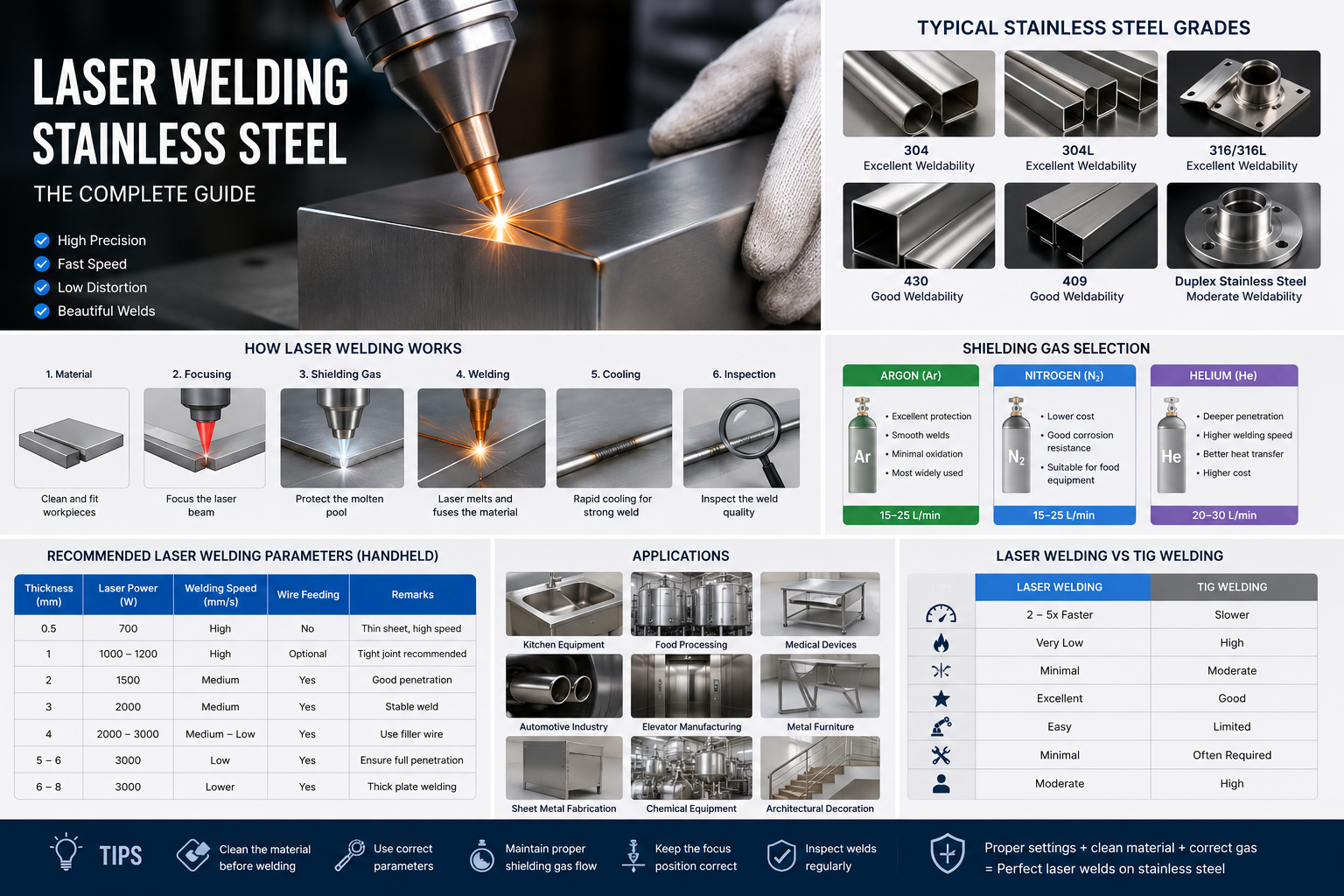
How Laser Welding Stainless Steel Works
Understanding the complete welding process helps manufacturers optimize weld quality and improve production efficiency.
The typical laser welding stainless steel workflow includes seven steps.
Step 1. Material Preparation
Surface cleanliness directly affects weld quality.
Before welding:
- Remove oil
- Remove grease
- Remove rust
- Remove oxide layers
- Remove paint
- Eliminate moisture
Even minor contamination can lead to porosity and poor fusion.
Step 2. Workpiece Positioning
Proper fixturing ensures accurate alignment.
The joint gap should typically remain below 0.2 mm for autogenous (wire-free) laser welding.
Good positioning minimizes:
- Weld deviation
- Burn-through
- Lack of fusion
Step 3. Laser Beam Focusing
The laser beam is concentrated into a very small focal spot.
Proper focus provides:
- Stable penetration
- Higher energy density
- Narrow weld seams
- Reduced heat input
An incorrect focus position can significantly reduce weld quality.
Step 4. Shielding Gas Protection
Shielding gas protects the molten pool from atmospheric contamination.
Common gases include:
- Argon
- Nitrogen
- Helium
Proper gas flow helps prevent:
- Oxidation
- Porosity
- Surface discoloration
We’ll discuss gas selection in detail later in this guide.
Step 5. Molten Pool Formation
Once the laser reaches sufficient energy density, the stainless steel begins melting almost instantly.
Depending on power level, two welding modes are possible:
Conduction Mode
Characteristics:
- Smooth surface
- Wide weld bead
- Shallow penetration
- Excellent appearance
Suitable for:
- Thin sheets
- Decorative products
Keyhole Mode
Characteristics:
- Deep penetration
- Narrow weld
- High efficiency
Suitable for:
- Structural components
- Thick stainless steel
- Industrial manufacturing
Most fiber laser welding stainless steel applications operate in keyhole mode due to its superior penetration capability.
Step 6. Rapid Cooling
After the laser passes, the molten metal solidifies rapidly.
Benefits include:
- Fine grain structure
- Small heat-affected zone
- Low deformation
- High mechanical strength
Rapid cooling is one of the primary reasons laser welding stainless produces cleaner welds than traditional arc welding.
Step 7. Weld Inspection
Finished welds should be inspected for:
- Surface smoothness
- Penetration consistency
- Porosity
- Undercut
- Cracks
- Dimensional accuracy
For high-end manufacturing, additional inspections such as X-ray testing or dye penetrant testing may also be performed.
Best Laser Welding Machines for Stainless Steel
Choosing the right equipment depends on production volume, material thickness, and application requirements.
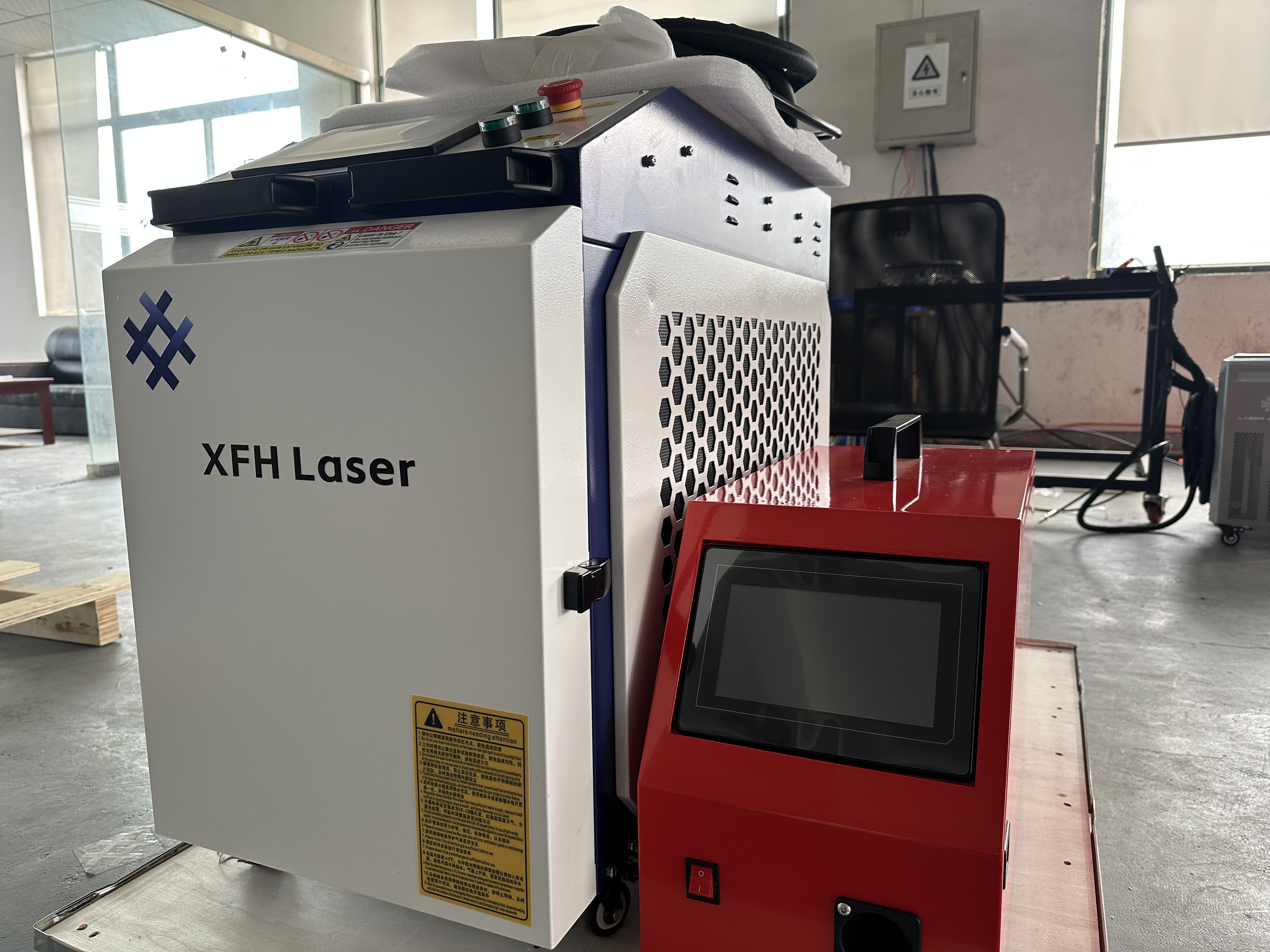
Handheld Fiber Laser Welding Machine
Handheld laser welders have become the preferred choice for small and medium-sized manufacturers.
Advantages include:
- Easy operation
- Minimal training
- High flexibility
- Low maintenance
- Portable design
Suitable for:
- Sheet metal fabrication
- Kitchen equipment
- Stainless steel doors
- Furniture
- Advertising signs
- Cabinet manufacturing
Typical power options:
| Power | Recommended Thickness |
|---|---|
| 700W | 0.4–2 mm |
| 1200W | 0.4–3 mm |
| 1500W | 0.4–4 mm |
| 2000W | 0.4–6 mm |
| 3000W | 0.4–8 mm |
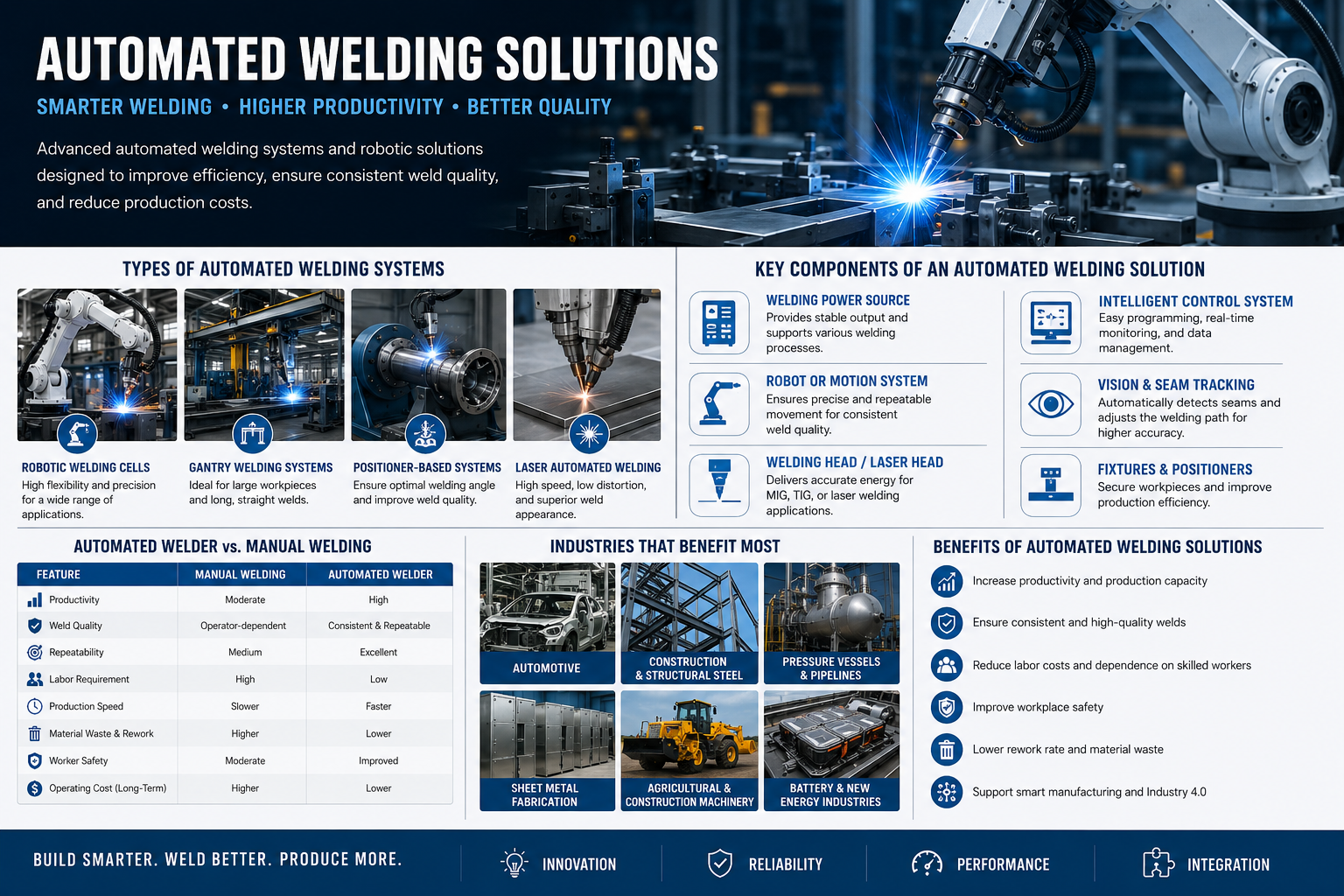
Automated Laser Welding System
For mass production, automated systems provide:
- Consistent weld quality
- Higher productivity
- Reduced labor costs
- Continuous operation
Common industries include:
- Automotive manufacturing
- Battery production
- Medical equipment
- Household appliances
Robotic Laser Welding
Robotic systems combine industrial robots with fiber laser sources.
Advantages include:
- Multi-axis movement
- Complex weld paths
- High repeatability
- 24/7 production capability
Ideal for:
- Automotive frames
- Battery trays
- Precision components
- Large structural assemblies
Recommended Laser Welding Parameters
Selecting the proper laser welding stainless steel parameters is critical for achieving strong welds, minimizing distortion, and maintaining production efficiency.
The following table provides general recommendations for handheld fiber laser welding systems.
Note: Actual settings vary depending on joint type, laser source, focal position, shielding gas, and machine configuration. Always perform sample welding before full-scale production.
Several key parameters influence weld quality:
Laser Power
Higher power increases penetration but excessive power may cause burn-through or excessive spatter.
Welding Speed
- Too fast → Incomplete fusion
- Too slow → Excessive heat input and distortion
Focus Position
Proper focus ensures maximum energy density and stable weld formation.
Oscillation Width
A slight beam oscillation helps bridge joint gaps, improves weld bead appearance, and enhances tolerance for part fit-up.
Wire Feeding
Filler wire is recommended for:
- Large joint gaps
- Thick stainless steel
- Edge repairs
- Corner welds
For thin sheets with tight fit-up, wire feeding is often unnecessary, allowing for faster and cleaner welding.
Choosing the Right Shielding Gas
Selecting the proper shielding gas is one of the most important factors in laser welding stainless steel. Shielding gas protects the molten weld pool from oxygen, nitrogen, and moisture in the air, helping produce cleaner welds, better penetration, and improved corrosion resistance.
An inappropriate gas or incorrect gas flow can result in oxidation, porosity, discoloration, and reduced weld strength.
The three most common shielding gases are Argon, Nitrogen, and Helium.
| Shielding Gas | Advantages | Typical Applications |
|---|---|---|
| Argon (Ar) | Excellent weld appearance, stable arc, low oxidation | General stainless steel fabrication |
| Nitrogen (N₂) | Lower cost, good corrosion resistance | Food equipment, sheet metal |
| Helium (He) | Deep penetration, high heat transfer | Thick plates, aerospace, high-end manufacturing |
Argon
Argon is the most widely used shielding gas for laser welding stainless steel because it provides the best balance between weld quality and ease of use.
Advantages include:
- Excellent protection against oxidation
- Smooth and bright weld seams
- Stable molten pool
- Minimal spatter
- Suitable for almost all stainless steel grades
Recommended gas flow:
15–25 L/min
Argon is ideal for:
- 304 stainless steel
- 316 stainless steel
- Decorative products
- Kitchen equipment
- Precision sheet metal fabrication
Nitrogen
Nitrogen is another popular option for stainless steel laser welding, particularly where operating costs are a concern.
Advantages include:
- Lower operating cost than argon
- Good corrosion resistance for austenitic stainless steels
- Stable weld quality in many industrial applications
Typical applications:
- Food machinery
- Stainless steel cabinets
- Metal furniture
- Commercial kitchen equipment
However, nitrogen may not be suitable for every stainless steel grade. Always perform welding trials before mass production.
Helium
Helium offers superior thermal conductivity and produces deeper penetration than argon.
Advantages:
- Higher welding speed
- Better penetration
- Improved weld profile
- Reduced porosity
Disadvantages:
- Higher cost
- Greater gas consumption
Helium is generally reserved for:
- Aerospace components
- Thick stainless steel
- High-value precision manufacturing
Recommended Gas Selection
| Application | Recommended Gas |
|---|---|
| General fabrication | Argon |
| Decorative stainless steel | Argon |
| Food equipment | Argon / Nitrogen |
| Medical equipment | Argon |
| Thick stainless steel | Helium or Argon-Helium mixture |
Applications of Laser Welding Stainless Steel
The demand for laser welding stainless steel continues to grow across a wide range of industries due to its speed, precision, and ability to produce visually appealing welds.
Below are some of the most common applications.
Sheet Metal Fabrication
Sheet metal processing is one of the largest markets for laser welding stainless.
Typical products include:
- Electrical cabinets
- Control boxes
- Distribution cabinets
- Enclosures
- Industrial housings
Laser welding minimizes distortion, helping manufacturers maintain dimensional accuracy even with thin stainless steel sheets.
Kitchen Equipment
Commercial kitchens require hygienic, corrosion-resistant stainless steel products.
Common applications include:
- Stainless steel sinks
- Kitchen cabinets
- Worktables
- Range hoods
- Food preparation equipment
Because laser welds are smooth and clean, they are easier to sanitize and require less polishing than traditional TIG welds.
Food Processing Equipment
Food-grade stainless steel equipment demands high-quality welds that resist corrosion and contamination.
Laser welding is commonly used for:
- Storage tanks
- Mixing vessels
- Conveyors
- Stainless steel pipelines
- Filling machines
The narrow heat-affected zone helps preserve the corrosion resistance of stainless steel, making laser welding an excellent choice for food-processing applications.
Medical Devices
Medical products often require extremely clean and precise welds.
Applications include:
- Surgical instruments
- Medical carts
- Sterilization equipment
- Stainless steel frames
- Laboratory equipment
The precision of fiber laser welding stainless steel allows manufacturers to produce high-quality joints with minimal finishing.
Automotive Industry
Automotive manufacturers increasingly rely on laser welding for stainless steel components because of its high production efficiency.
Typical applications include:
- Exhaust systems
- Battery trays
- Structural brackets
- Heat shields
- Decorative trim
Laser welding also integrates easily with robotic production lines, improving consistency and throughput.
Elevator Manufacturing
Modern elevators contain a significant amount of decorative stainless steel.
Laser welding is used for:
- Door panels
- Cabin walls
- Control panels
- Handrails
- Interior decorations
The smooth weld appearance reduces polishing time and enhances the final product’s aesthetics.
Metal Furniture
Furniture manufacturers benefit from the flexibility of handheld laser welding systems.
Applications include:
- Stainless steel chairs
- Tables
- Shelving
- Display racks
- Hotel furniture
Compared with TIG welding, laser welding delivers cleaner joints and significantly higher production efficiency.
Advantages of Laser Welding Stainless Steel
Compared with conventional welding technologies, laser welding stainless steel offers numerous technical and economic advantages.
Faster Production Speed
One of the most significant benefits is productivity.
Laser welding can often be 2–5 times faster than TIG welding, depending on material thickness and joint configuration.
Higher productivity means:
- Shorter production cycles
- Increased factory output
- Faster customer delivery
- Lower labor costs
Minimal Heat Distortion
The laser concentrates energy into an extremely small area.
Benefits include:
- Less thermal expansion
- Lower residual stress
- Better dimensional accuracy
- Reduced rework
This is particularly important for precision stainless steel products.
Superior Weld Appearance
Laser welds are typically:
- Smooth
- Narrow
- Uniform
- Bright
- Low spatter
In many cases, polishing is either minimal or unnecessary, reducing finishing costs and improving production efficiency.
Lower Operating Costs
Although laser welding equipment requires a higher initial investment, long-term operating costs are often lower because of:
- Reduced labor
- Less filler wire consumption
- Minimal grinding
- Lower rework rates
- Faster production
These savings make stainless steel laser welding highly cost-effective for manufacturers with medium to high production volumes.
Easier Automation
Fiber laser systems integrate seamlessly with:
- Industrial robots
- CNC platforms
- Automatic wire feeders
- Vision positioning systems
- Smart production lines
Automation improves consistency while reducing dependence on highly skilled manual welders.
Environmentally Friendly
Compared with traditional welding methods, laser welding typically generates:
- Less smoke
- Less spatter
- Lower material waste
- Lower energy consumption
- Cleaner working environments
This supports modern manufacturers in achieving more sustainable production.
Common Welding Defects and Solutions
Even with advanced fiber laser technology, improper machine settings or poor material preparation can lead to welding defects. Understanding these common issues and their solutions will help improve production efficiency and ensure consistent weld quality.
| Welding Defect | Possible Cause | Recommended Solution |
|---|---|---|
| Porosity | Contaminated surface, insufficient shielding gas | Clean the material thoroughly and increase gas flow |
| Burn-Through | Excessive laser power, slow welding speed | Reduce power or increase travel speed |
| Lack of Penetration | Low laser power, incorrect focus position | Increase power or adjust the focal point |
| Undercut | Excessive welding speed | Reduce travel speed and optimize oscillation |
| Cracks | Improper heat input or unsuitable material | Optimize parameters and use filler wire if necessary |
| Excessive Spatter | Incorrect focus or unstable power | Recalibrate focus and stabilize welding settings |
| Surface Oxidation | Poor shielding gas coverage | Use high-purity argon and ensure proper gas flow |
Porosity
Porosity appears as tiny holes inside or on the surface of the weld. It is often caused by oil, moisture, or oxidation on the workpiece.
How to prevent it:
- Clean the material before welding.
- Use high-purity shielding gas.
- Maintain a stable gas flow.
- Keep the laser nozzle clean.
Burn-Through
Burn-through occurs when excessive heat melts completely through thin stainless steel.
Solutions:
- Reduce laser power.
- Increase welding speed.
- Increase the laser spot size if necessary.
- Practice on sample materials before production.
Lack of Penetration
Insufficient penetration reduces weld strength and may lead to premature failure.
Common causes include:
- Low power
- Excessive welding speed
- Improper focus position
- Large joint gaps
For thicker materials, increasing laser power and using filler wire often improves penetration.
Surface Oxidation
Stainless steel should maintain its bright appearance after welding. Blue, yellow, or black discoloration usually indicates inadequate shielding.
Improve weld appearance by:
- Increasing argon flow.
- Checking gas nozzle alignment.
- Reducing excessive heat input.
- Maintaining a consistent welding speed.
Best Practices for Laser Welding Stainless Steel
Whether you are using a handheld laser welder or an automated production line, following best practices can significantly improve weld quality and equipment performance.
Clean the Material Thoroughly
Always remove:
- Oil
- Dust
- Paint
- Oxides
- Moisture
Surface contamination is one of the leading causes of weld defects.
Choose the Correct Laser Power
Selecting the appropriate power based on material thickness helps balance penetration and weld appearance.
Using excessive power may result in:
- Burn-through
- Excessive heat input
- Surface discoloration
Insufficient power can lead to incomplete fusion.
Maintain Consistent Welding Speed
A steady travel speed ensures uniform heat input throughout the weld.
Avoid:
- Sudden stops
- Sharp speed changes
- Irregular hand movement
For handheld laser welding, operator consistency is essential for producing high-quality welds.
Optimize Shielding Gas
Proper gas selection and flow directly affect:
- Corrosion resistance
- Weld appearance
- Surface cleanliness
- Mechanical strength
Argon remains the preferred choice for most laser welding stainless steel applications.
Perform Sample Welds
Before beginning large production runs:
- Test welding parameters.
- Verify penetration.
- Inspect weld appearance.
- Adjust settings if necessary.
This simple step can prevent costly production errors.
Inspect Weld Quality Regularly
Routine inspections help identify problems before they affect product quality.
Typical inspection methods include:
- Visual inspection
- Penetration testing
- Dimensional measurement
- Mechanical testing
- X-ray inspection (for critical applications)
Laser Welding Stainless Steel vs TIG Welding
Both laser welding and TIG welding are widely used for stainless steel fabrication. However, each process offers distinct advantages depending on production requirements.
| Feature | Laser Welding | TIG Welding |
|---|---|---|
| Welding Speed | ★★★★★ | ★★☆☆☆ |
| Heat Input | Very Low | High |
| Distortion | Minimal | Moderate |
| Weld Appearance | Excellent | Good |
| Automation | Excellent | Limited |
| Operator Skill Requirement | Moderate | High |
| Productivity | Very High | Medium |
| Post-Processing | Minimal | Often Required |
| Thin Sheet Performance | Excellent | Good |
| Thick Material Capability | Excellent (with proper power) | Excellent |
When to Choose Laser Welding
Laser welding is the ideal solution if you need:
- High production efficiency
- Consistent weld quality
- Low heat distortion
- Attractive weld appearance
- Easy integration with automation
- Reduced finishing costs
When TIG Welding May Still Be Suitable
TIG welding remains a practical choice for:
- Small repair jobs
- Low-volume production
- Extremely thick materials requiring multiple passes
- Workshops with limited equipment investment
However, as labor costs continue to rise, more manufacturers are transitioning to stainless steel laser welding to improve efficiency and reduce overall production costs.
Frequently Asked Questions (FAQ)
1. Can stainless steel be laser welded?
Yes. Austenitic stainless steels such as 304, 304L, 316, and 316L are among the easiest materials to weld using fiber laser technology.
2. Is laser welding stronger than TIG welding?
When proper parameters are used, laser welds can achieve mechanical strength comparable to or even exceeding TIG welds, while producing a smaller heat-affected zone.
3. Does laser welding require filler wire?
Not always. Thin stainless steel with tight joint fit-up can often be welded without filler wire. Thicker materials or larger joint gaps usually benefit from filler wire.
4. What is the best shielding gas for laser welding stainless steel?
High-purity argon is generally the preferred shielding gas because it provides excellent oxidation protection and produces clean, bright welds.
5. How thick can a handheld laser welder weld stainless steel?
Depending on the laser power and joint design, most handheld fiber laser welders can weld stainless steel ranging from 0.5 mm to 8 mm.
6. Is laser welding suitable for food-grade stainless steel?
Yes. Laser welding produces clean, smooth welds with minimal contamination, making it ideal for food processing equipment and commercial kitchen applications.
7. Can laser welding reduce polishing time?
Absolutely. Because laser welds are narrow and produce very little spatter, post-processing is often significantly reduced compared with traditional welding methods.
8. Is laser welding environmentally friendly?
Yes. Laser welding generates less smoke, less waste, and lower energy consumption than many conventional welding processes, supporting cleaner manufacturing.
9. Which industries benefit most from laser welding stainless steel?
Industries such as sheet metal fabrication, kitchen equipment, food processing, automotive, medical devices, elevators, furniture manufacturing, and industrial machinery all benefit from laser welding technology.
10. How do I choose the right laser welding machine?
Consider the following factors:
- Material thickness
- Production volume
- Required welding speed
- Automation needs
- Budget
- Future expansion plans
Selecting the appropriate laser power and machine configuration will ensure long-term productivity and reliable weld quality.
Conclusion
As manufacturing continues to demand higher efficiency, greater precision, and lower production costs, laser welding stainless steel has become one of the most valuable technologies in modern metal fabrication.
Compared with conventional TIG and MIG welding, fiber laser welding offers faster processing speeds, minimal heat distortion, cleaner welds, and significantly lower post-processing requirements. Whether you are manufacturing kitchen equipment, sheet metal enclosures, automotive components, food processing machinery, or medical devices, laser welding provides the consistency and productivity needed to remain competitive.
To achieve the best results, manufacturers should pay close attention to material preparation, laser power, welding speed, focus position, shielding gas selection, and routine quality inspection. Optimizing these factors not only improves weld quality but also extends equipment life and reduces operating costs.
As handheld laser welders and automated laser welding systems continue to evolve, more businesses are replacing traditional welding methods with fiber laser technology to increase efficiency and improve product quality. Investing in the right equipment and understanding the fundamentals of laser welding stainless steel will help manufacturers meet today’s production challenges while preparing for future growth.
Ready to Upgrade Your Stainless Steel Welding?
Whether you are looking for a portable handheld laser welder for flexible fabrication or a fully automated laser welding solution for high-volume production, choosing the right equipment is the key to achieving outstanding weld quality and maximizing productivity.
At XFH LASER, we provide advanced fiber laser welding machines designed for a wide range of stainless steel applications. Our systems deliver stable performance, user-friendly operation, and professional technical support to help manufacturers improve efficiency and reduce production costs.
Contact the XFH LASER Engineering Team today to discuss your welding requirements, request a free sample weld, or receive expert recommendations tailored to your materials, thickness, and production needs.